Showing posts with label trading. Show all posts

Tuesday, January 3, 2012

Why I Love Trading the Retailers

This morning, in a generally strong market, and especially strong market for retailers, Zumiez (ZUMZ) has been dropping like a stone.  Here's a two-week chart (30 min. bars) of XRT, the SPDR S&P Retail ETF:


Here's Zumiez (ZUMZ), same scale:

There's no hard news on the tape for ZUMZ, but Piper Jaffray (PJC) has a research note out, and has downgraded ZUMZ to neutral from outperform.  I haven't seen the note, but for the stock to be down big in a good market, the opinion must be pretty bad, and the data must be pretty solid.

Ever since August 2000, when the SEC instituted Regulation FD, it has been exceedingly difficult to be a consistent winner as a purely technical trader. Prior to that, it was possible to figure out what the "smart guys" were doing by reading the charts, and looking for clues in price and volume action. The charts gave us a graphical picture of big money psychology and information flow. A savvy trader could piggyback on the big money by trading the charts (moving ahead of the public), and make nice profits by "selling the news" when important announcements (earnings, patents, FDA approvals, etc) were made.

This selective information flow has been completely cut off by Regulation FD. Corporate insiders are a weaselly bunch, but they're not going to risk a big fine or jail time by "spilling the beans" on earnings to a buddy over a 3-martini lunch. So, analysts, street touts, mutual funds, and other "wise guys" are in the same boat that the public is; they're left to read the tea leaves by pawing through publicly available information such as SEC filings, newspaper and magazine articles, online news sources, message boards, and rumors. It's still possible for smart guys (big and small money) to beat the market, but you can no longer do it with non-public information. (Except for crooks like Raj Rajaratnam, Roger Blackwell, Joe Nacchio, Martha Stewart, and U.S. Congressmen.)

There is one exception: the retailers. If you are a low-paid manager of a Zumiez store in Smallville Mall, you have some pretty valuable information at your fingertips: sales, margins, comparisons to last year for your store. And if you are a hard-working analyst at Piper Jaffray who has a network of fifty of these managers in his Rolodex (does anybody really use Rolodexes anymore?), you have a pretty damn good picture of how the company is doing, with no need for information from the CEO. In fact, you may have better information than the CEO! Look for ZUMZ to close down a few percent today on higher than average volume, and for the company to be down even harder on the next same-store sales or earnings announcement.

Consequently, if you read your charts closely, you will notice that the average stock tends to show big moves on heavy volume, and lots of sitting around on light volume in between...no follow-through. Retail stocks, on the other hand, tend to be better behaved, moving in gentle arcs and holding their trend lines for longer periods. These stocks do follow through on breakouts and breakdowns. This is why I love trading the retailers, it's still possible to beat the market using pure technical analysis.

Friday, August 26, 2011

The Perfect Storm: Trading Home Depot around Hurricane Irene

Today, we have a very nice setup for trading Home Depot (HD).  Hurricane Irene is currently bearing down on the Outer Banks of North Carolina,  a lovely stretch of beach in the midst of vacation season.

A brief history/geography lesson on the Outer Banks.  A famous vacation spot, The Outer Banks is a thin (usually less than 1/2 mile wide) barrier island separating the Atlantic Ocean from Pamlico Sound and mainland North Carolina.  It has been the scene of many vicious storms in the past; an 1846 hurricane opened , which is now the site of a 2-1/2 mile long bridge:

"Whoa!" you may say.  A storm did that! Unbelievable! I would never build a nice house there.  And for many years, people didn't.  Here's a typical 1960's-era cottage:

Nice! Small but comfortable, close to nature, and no big deal if it gets washed away. But, as usual, people forgot how powerful Mother Nature can be, and she fortuitously chose to ignore the Outer Banks. By the 2000's, people were building homes like this:

Ridiculous! Talk about hubris! Or maybe stupidity. Needless to say, if Hurricane Irene is anything like the 1846 storm, this million-dollar home will be reduced to splinters.

Anyway, Irene is currently headed directly for the Outer Banks. After that, it's projected to roll through the heavily-populated Northeast USA, from Washington to Boston. Damage is projected to reach the billions. And when residents wake up Monday morning, and start repairing windows, doors, shingles, and possibly rebuilding homes, where will they start?  Yup, Home Depot.

Of course, if I know this so does every wit and half-wit with a brokerage account. Consequently, as the storm track has crystallized, HD stock has been ramping up. It is currently trading at 34.15, up 7% from last Friday's close at 31.88. Here's the kicker: since Irene's full thrust will be felt mostly tonight and this weekend, the ultimate damage will be done while the market is closed. This means that a nimble options trader can profit a bit more from a post-storm "sell the news" move in HD.

HD's historical volatility is about 32%. September around-the-money options are trading at implied volatilities from the high-30s to nearly 50 (Sept 30 Puts). The smart(?) guys are betting on the weather! I expect implied volatility to collapse back to it's long term average on Monday. So the play today is to sell volatility. Here are a few possible strategies.

For long-term HD shareholders: Sell out-of-the-money calls, like the Sept 35 Calls for .70.  By selling out-of-the-moneys, you won't run afoul of the IRS and won't owe any taxes on the underlying shares unless they're exercised. If they're called away, you'll have benefited from this week's 7% gain,  plus .85 appreciation (2.5%), plus .70 options premium (2%). Total profit since last Friday: 11.5%. Profit from today: 4.5%. Not bad in a low-return world. You can also buy back the calls on Monday, after volatility collapses, if you're married to the stock.

For short-term HD shareholders: Sell slightly in-the-money calls, like the Sept 33 Calls for 1.85.  This gives you a .70 (2%) premium in a pretty sleepy stock, and it can drop nearly 4% before your protection runs out.  Of course, you're giving up any upside if Irene is even worse than expected, and HD adds to it's already impressive run.  Still, you will benefit from collapsing IV.

For non-directional options traders: Sell high-IV options, and protect yourself with lower IV options. For example, sell the Sept 30 Puts for .27 (IV=50%) and buy the Nov 30 Puts for .97 (IV=40%) for a net debit of .70. Cover early next week for a small profit as IV collapses. Even bigger bump if HD fades.

For bullish options traders: Sell high-IV puts. For example, sell the Sept 32 Puts for .54 (IV=41%). If HD rallies next week, pocket the .54. If it drops, you can buy it 9.4% cheaper if it falls through 32 (your breakeven is 31.46, 10% below today's price). Don't be afraid of selling naked puts! It's a very conservative strategy; Warren Buffet uses it to buy companies he likes at a discount, and generate income to boot.

For bearish options traders: Sell high-IV calls, like the Sept 33 Calls for 1.80 (IV=38%). If HD drops next week, pocket the .65 risk premium, plus whatever the drop is, to a max profit of 1.80 at 33 or below. If it rallies into expiration, your effective short price is 2% higher than today's price.

(Updated 1:30pm; just thought of another one)
For neutral options traders: Sell at-the-money puts and calls.  Sell Sept 34 puts for 1.10, Sell Sept 34 calls for 1.13. (HD now at 34.30). Trade is a winner if HD closes between 31.77 and 36.23 on 9/16. Or, exit the trade early next week. Seems like a nice risk/reward here as premium covers +/-6.5% move in 3 weeks.

Note that the "wise guys" are betting on a post-Irene drop, as IVs are higher on the put side than on the call side. They're expecting a "sell the news" reaction early next week, regardless of Irene's ultimate damage. Whatever you do, don't buy options outright in this environment! You could easily be right on HD's direction, and still lose money to collapsing volatility!

Also, stick to the more liquid strikes/expirations, as volume is likely to dry up post-Irene and you may be stuck having to leg out of a multi-leg option into an illiquid market...another good way to turn a winner into a loser!

Wednesday, August 24, 2011

Bernanke Knows His Keynes

"Perhaps a complex offer by the central bank to buy and sell at stated prices gilt-edged bonds of all maturities, in place of the single bank rate for short-term bills, is the most important practical improvement which can be made in the technique of monetary management."

Keynes, John Maynard (2010-12-30). The General Theory of Employment, Interest and Money

Wednesday, August 3, 2011

Take Some Francs off the Table

On June 14, I shorted the Euro against the Swiss Franc (EURCHF) at 1.21.  The Euro has obediently fallen to a low below 1.08, before staging a massive rally overnight when the Swiss dropped interest rates to nada%, matching the rest of the world. (Expect this headline soon: "Swiss Bankers Head to Rio, Excited to Dance in Carnival Parade")  EURCHF is currently trading just under 1.11, time to unwind the position.

The Swiss Franc is still an unrivaled safe haven, but has gotten way ahead of itself.  We recently met some American expatriates living in Switzerland, they were stocking up on Ugh boots as they could buy three pairs in the US for the price of one in Switzerland!  Another data point: a small Diet Coke costs $12 in Zurich! We'll continue to watch the Franc for a good re-entry point.

Some of the European safe haven money will look elsewhere on the Swiss Central Bank news.  Look for the other safe havens to rally today:  US Treasuries, gold, silver.

Friday, July 29, 2011

D.C. Fiddles While the Economy Burns: What the Market is Telling Us

As the endless debt ceiling nonsense continues unabated this morning, the markets are telling an interesting story.  SPY (which represents the S&P 500) is down .75%, while TLT (ETF for 20-year treasuries) is up 1.34%!  What's going on?

The message is split.  If the current "Capital Hill Circle Jerk"© proceeds through Aug. 2 (only 4 days away!), the government will be forced into a partial shutdown: workers will be furloughed, parks will be closed, medicare and medicaid reimbursements may be held back, and social security checks may be reduced or delayed.  Certain to cause an economic slowdown, or maybe a double-dip recession!

Whether or not a deal is reached before "Tim Geithner Turns Into A Pumpkin Day", it's becoming more and more clear that real spending cuts are coming down the pike, and they'll hurt.  Contrary to Tea Party rhetoric, austerity is not good for the economy (at least in the short term).  So, regardless of the timing of a debt deal, this will exacerbate an economic slowdown.

On the other hand, the sturm and drang over potential default has been overdone.  Interest payments are not due till August 15, nearly two weeks after Geithner's spending cuts kick in.  Well before that time, the entire country will be in a lather, the political pressure will be too much, and a deal will certainly be made.  Additionally, if Uncle Sam tries to stiff bondholders, expect the courts to issue an injunction preventing default, as I suggested here. Treasuries are gaining further strength because the market anticipates economic weakness, as mentioned above.

So, I was wrong a few weeks ago.  Buy treasuries here.

Friday, July 15, 2011

Hey, D.C.: Would Dow Down 1000 Get Your Attention?

As I write this, Congress and President Obama are engaged in a high-stakes game of chicken on the debt limit.  Congressional Republicans (mostly Tea Partiers) refuse to increase the nation's credit limit without major spending cuts.  Further, they've rejected any tax increases as a way toward fiscal sanity.

The media is in an absolute tizzy over the possibility of default.  Will interest rates skyrocket?  Will our economy grind to a halt?  Will social security checks and Medicare reimbursements be scuttled?  And what about the Armed Services?  Will our brave fighting men get paid?

Interestingly,  the markets have largely yawned over the whole thing.  US Government bonds (after a week-long plunge on the heels of QE2 expiration at the end of June) have rallied back to where they were in mid-June.  The stock market has done it's usual midsummer random walk/drunken stagger.  In short, the markets think that a deal will be reached (after each side makes a big show of storming out of meetings, a few Tea Party nuts threaten to let the country default, and the Congressional Cots are dusted off for an all-nighter).

But, what if the markets are wrong?   I know, I know, the markets are always right.  But what if the Tea Partiers really are crazy enough to let the country default?  What if the Dennis Kucinich Democrats decide to go to the wall over entitlement cuts?  What if we really get close to Tim Geitner's Aug. 2 drop-dead date without a deal?

As this possibility dawns on Wall Street, expect yields to rise on all fixed income (corporates will follow Treasuries).  Slowly at first, then more vigorously.  The stock market will follow suit.  It could get really ugly.

Then, after the Dow is down about a thousand points or so, and TLT down 10, The Washington Wankers will finally get it!  It's time to get a deal done.  Because if they don't, nobody's getting re-elected.

Wednesday, June 22, 2011

A second chance at the Trade of the Decade

Last September, Doug Kass called "The Trade of the Decade":  short US long bonds.  TLT was at 106-ish when he made the call; it dropped to 88 before trading recently around 97.


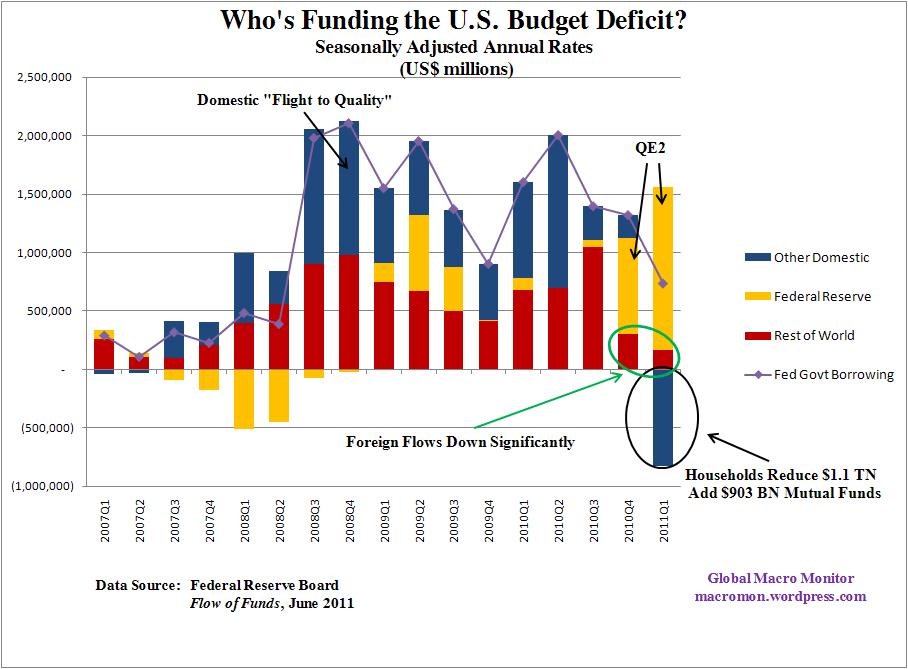
 Since bottoming in February, TLT has meandered its way back up.  U.S. equities have been running in place since then, the euro is a mess, and the economy has flatlined, leading to talk of a Japan-style "Lost Decade".  Most importantly, the Fed has been printing money, and using it to mop up supply of U.S. treasuries, in order to keep borrowing costs low and stimulate the economy.

Who else is buying treasuries?  As it turns out, nobody, as this chart from the Global Macro Monitor shows:


Bill Gross, Pimco's bond guru, has had his company out of treasuries since March.  The  Russians and Chinese, among others, consider US government debt radioactive (though the Chinese have recently resumed some lukewarm accumulation).  American individual investors read the news from Washington every day, no way they're buyers.  So, Ben Bernanke is backstopping the whole market...and he reiterated today that there would be no QE3 when QE2 expires at the end of this month!

So, why has TLT been drifting up recently, rather than heading down?  After all, none of this is a secret.  Well, the Eurozone is even more screwed up than the USA, so there's some "flight to quality" going on. Even though TLT doesn't really represent quality any more, old habits die hard.  Secondly, the old saw "don't fight the Fed" has governed many market participants; even though Bernanke says there will be no QE3 people don't believe him.  If things get bad enough, QE3 could be turned on as soon as enough 
currency stock and green ink can be trucked in.  Thirdly,  Congress is a wildcard.  The market thinks that there will eventually be a deal on the debt ceiling accompanied by spending cuts.  When and if this happens, market participants don't want to be short US Debt.  My feeling is that Congress will reach an 11th-hour deal, but it will be watered-down and short-term.  It's impossible to reform our entitlement system on a short deadline, and both parties think they have staked out a winning position for next year's election.

Interesting clue in today's trading.  Bernanke spoke at 2pm today and was quite downbeat on the economy, trimming growth estimates for this year and next.  Normally, great news for the bond market; this time, nary a peep:


Like Sherlock Holmes, we can learn a lot from the dog that didn't bark.  A market that doesn't rally on good news is destined to go down.  This looks like a great time to enter "The Trade of the Decade" if you missed it late last year.  If you need an extra adrenaline rush, buy TBT (Proshares UltraShort 20+ year Treasury ETF).  If you prefer a more sedate lifestyle, short (or buy puts) on TLT.

Disclaimer:  I'm short TLT as of this afternoon.


Tuesday, June 14, 2011

How to Trade a Greek Default

In a thought-provoking piece, Andrew Lilico writes:
"What happens when Greece defaults. Here are a few things:

- Every bank in Greece will instantly go insolvent.

- The Greek government will nationalise every bank in Greece.

- The Greek government will forbid withdrawals from Greek banks.

- To prevent Greek depositors from rioting on the streets, Argentina-2002-style (when the Argentinian president had to flee by helicopter from the roof of the presidential palace to evade a mob of such depositors), the Greek government will declare a curfew, perhaps even general martial law.

- Greece will redenominate all its debts into “New Drachmas” or whatever it calls the new currency (this is a classic ploy of countries defaulting)

- The New Drachma will devalue by some 30-70 per cent (probably around 50 per cent, though perhaps more), effectively defaulting 0n 50 per cent or more of all Greek euro-denominated debts.

- The Irish will, within a few days, walk away from the debts of its banking system.

- The Portuguese government will wait to see whether there is chaos in Greece before deciding whether to default in turn.

- A number of French and German banks will make sufficient losses that they no longer meet regulatory capital adequacy requirements.

- The European Central Bank will become insolvent, given its very high exposure to Greek government debt, and to Greek banking sector and Irish banking sector debt.

- The French and German governments will meet to decide whether (a) to recapitalise the ECB, or (b) to allow the ECB to print money to restore its solvency. (Because the ECB has relatively little foreign currency-denominated exposure, it could in principle print its way out, but this is forbidden by its founding charter.  On the other hand, the EU Treaty explicitly, and in terms, forbids the form of bailouts used for Greece, Portugal and Ireland, but a little thing like their being blatantly illegal hasn’t prevented that from happening, so it’s not intrinsically obvious that its being illegal for the ECB to print its way out will prove much of a hurdle.)

- They will recapitalise, and recapitalise their own banks, but declare an end to all bailouts.

- There will be carnage in the market for Spanish banking sector bonds, as bondholders anticipate imposed debt-equity swaps.

- This assumption will prove justified, as the Spaniards choose to over-ride the structure of current bond contracts in the Spanish banking sector, recapitalising a number of banks via debt-equity swaps.  

- Bondholders will take the Spanish Banking Sector to the European Court of Human Rights (and probably other courts, also), claiming violations of property rights. These cases won’t be heard for years. By the time they are finally heard, no-one will care.

- Attention will turn to the British banks. Then we shall see…
Whether or not you believe Lilico's full cause-and-effect chain, it's clear that a Greek default will not be good for the euro or the core eurozone countries (principally Germany and France).  Greece's problems are well documented; indeed, the market's opinion of Greek government debt seems to be falling by the day, with the 10-year yielding 16.72% as I write this.


So, the market should be discounting the likelihood of default when valuing the Euro...is it?  Here's a chart of the Euro vs US Dollar:


 Ooops, the Euro is strengthening when it should be weakening...why?  My guess is the market is more worried about US Govt. debt than it is about Greek debt.  Let's compare the Euro to a couple of resource-backed currencies issued by countries with comparatively strong finances, Australia and Canada, and to the Swiss Franc, a traditionally strong currency:


 We see that the market has discounted EUR against each of these currencies to some degree...long CHF/ short EUR has been a huge win since Greek debt started to plunge in late 2009.  Europe's elite saw the writing on the wall, sold their euros in favor of the good old Swiss Franc.  (Switzerland's banks are not free of problems, but that's a story for another day.  Just being outside the Eurozone seems to be good enough.)

How long will this currency trend continue?  Until the market perceives a resolution of some kind is coming.  Given policymakers' fondness for "kicking the can down the road", I don't see this happening soon. Greece is out of options, and its politicos are whispering about leaving the Eurozone (many Northern Europeans would wish them good riddance). 

One solution making the rounds recently:  extend maturities on Greek debt, reducing current interest payments and buying time for the Greek Government to come up with more cash through cost-cutting, more efficient tax-collecting, and asset sales.  A couple of problems with this scenario:  recent austerity measures have caused massive dislocation in Greece--skyrocketing unemployment, striking employees, and angry protests.  GDP is shrinking.  How will Greece be better positioned to pay its debts in a few years than it is now?  And how will angry, unemployed Greeks feel about the Acropolis being sold to the highest bidder?  Sounds like more "can-kicking" to me.

Bottom line:  short the Euro on rallies against one of the safe-haven currencies (AUD and CHF look best).  Be very careful with CHF, however, as Switzerland's proximity to the Eurozone is likely to cause a furious counter-rally after Lilico's dominoes start to fall.